Panagia Tourliani

Tags
About
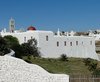
Drive north from Mykonos Town, past the windmills and the tourist-lined streets, and the island changes. The terrain rises into an interior that few visitors bother to explore, where the architecture turns quieter and the pace slows. After eight kilometers, you reach Ano Mera—a village square, a handful of tavernas, and one of the most significant religious sites in the Cyclades.
This is Panagia Tourliani, and it has stood here since 1542. The story behind its founding reads like something from an older world. Two monks arrived from Paros, fugitive from their island, seeking sanctuary on Mykonos. They settled at a small chapel dedicated to the Entrance of the Theotokos, where a nun named Tourli had lived.
The settlement that grew around them became Ano Mera—the name itself a testament to those earliest arrivals. The monks built what would become the spiritual anchor of an entire island. Over time, the monastery took on its current form through renovations completed between 1757 and 1767, led by a monk named Ignatios Basoulas.
The late eighteenth century brought additions that still define the site's character: a three-aisled church crowned with a marble façade, and a bell tower whose intricate reliefs date to 1806. These weren't afterthoughts or compromises. They were statements of devotion rendered in stone.
The Icon That Changed Everything
The name Tourliani itself carries weight. It derives from Tourlos, a bay on Mykonos's western coast where, according to tradition, a miraculous icon of the Virgin Mary was found floating on the sea. The icon's origins matter here. Local tradition attributes it to the Evangelist Luke, which would place its creation in the first century—an claim that believers accept without requiring proof.
What strikes visitors upon closer inspection is the icon's material. It was painted not on wood alone but on a plate of wax mixed with mastic from Chios, a combination that makes it resistant to woodworms and the humidity that destroys so many older works. The mixture has held for centuries. So has the belief surrounding it.
An early question arose about where to keep the icon permanently. Ano Mera, where the monks had settled, or Chora, where it had washed ashore? The resolution reflected practical wisdom and spiritual pragmatism: the icon would divide its time. During the winter months, including the period of Great Lent, it would remain in Chora at the church of Agia Kyriaki. When summer arrived, it would return to Ano Mera. Twice yearly, processions still carry it between locations—a tradition that has continued unbroken for generations.
What the Eye Finds
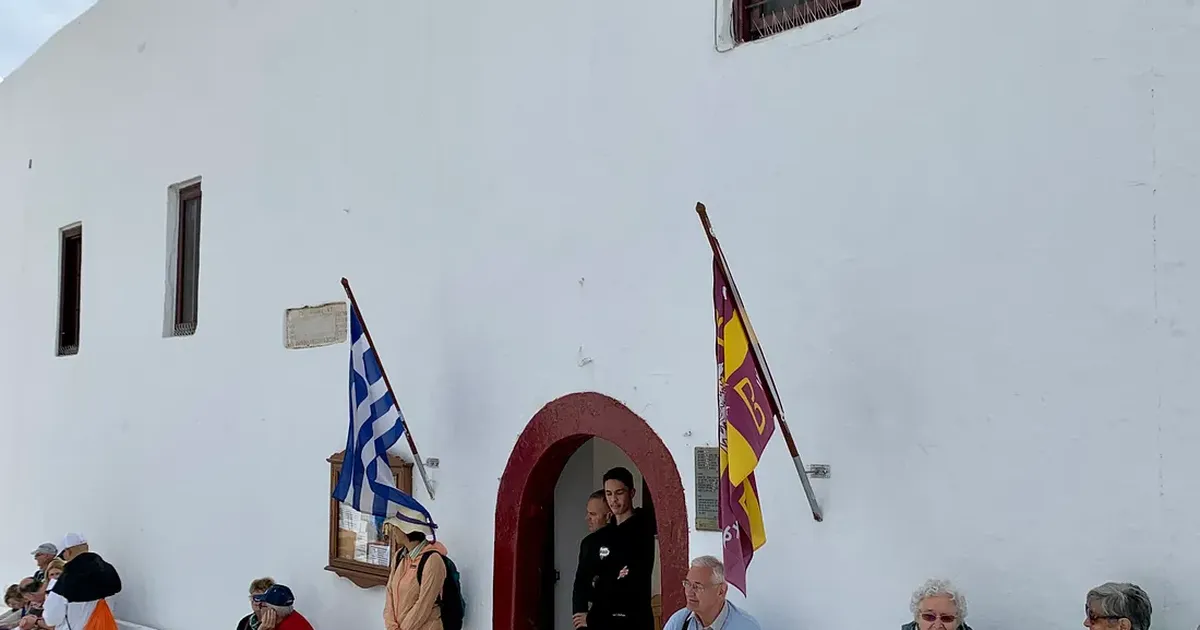
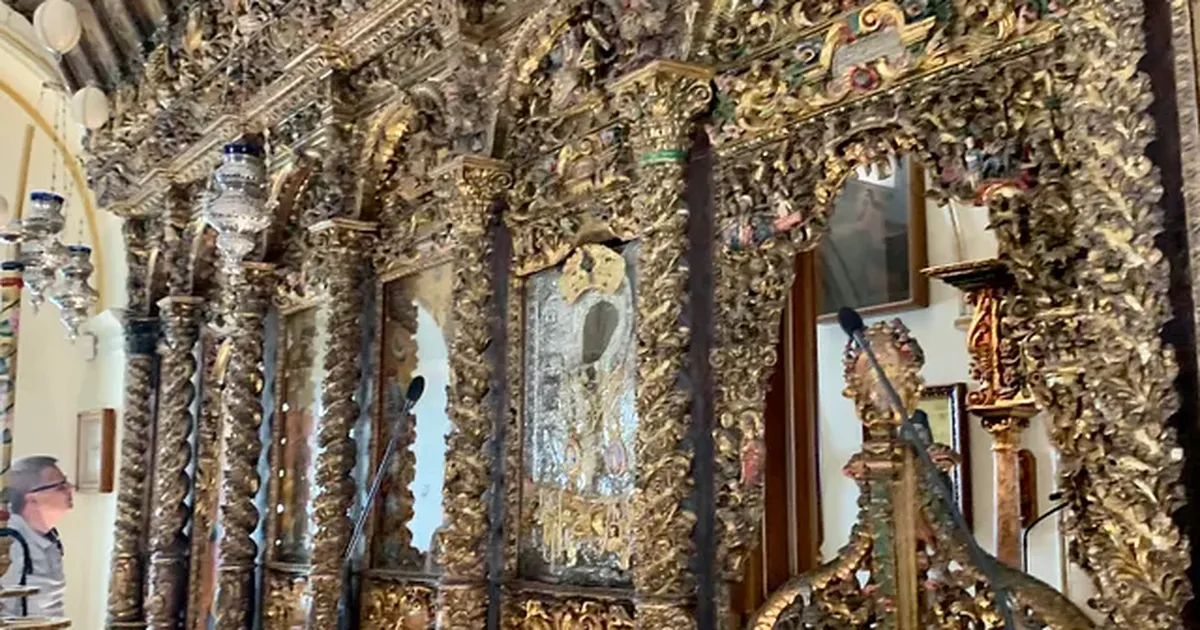
Panagia Tourliani does not announce itself with grandeur. The exterior is whitewashed, Cycladic, modest in the way that Cycladic religious architecture often is. But step inside and a different world emerges. The wooden iconostasis—the carved screen separating the nave from the altar—arrived in the late eighteenth century from Florence. This alone deserves attention. A wooden altar screen, baroque in its ornamentation, brought across the Aegean to a monastery on a small island whose livelihood came from the sea. The carvings unfold in green, red, and gold, flowers rendered in wood that somehow never look heavy or excessive.
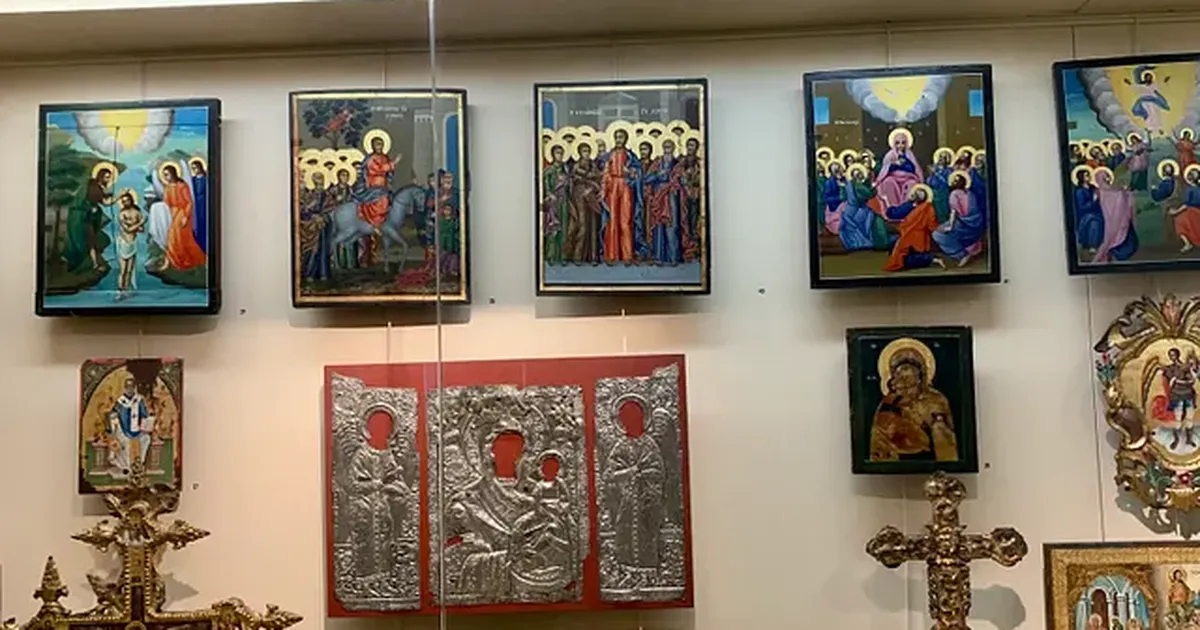
The icons lining the screen come from the hand of a painter identified simply as John from Kerkyra. His work anchors the devotional space, apostles and saints arranged as they would be in any Greek Orthodox church, yet the hand behind them carries its own regional character.
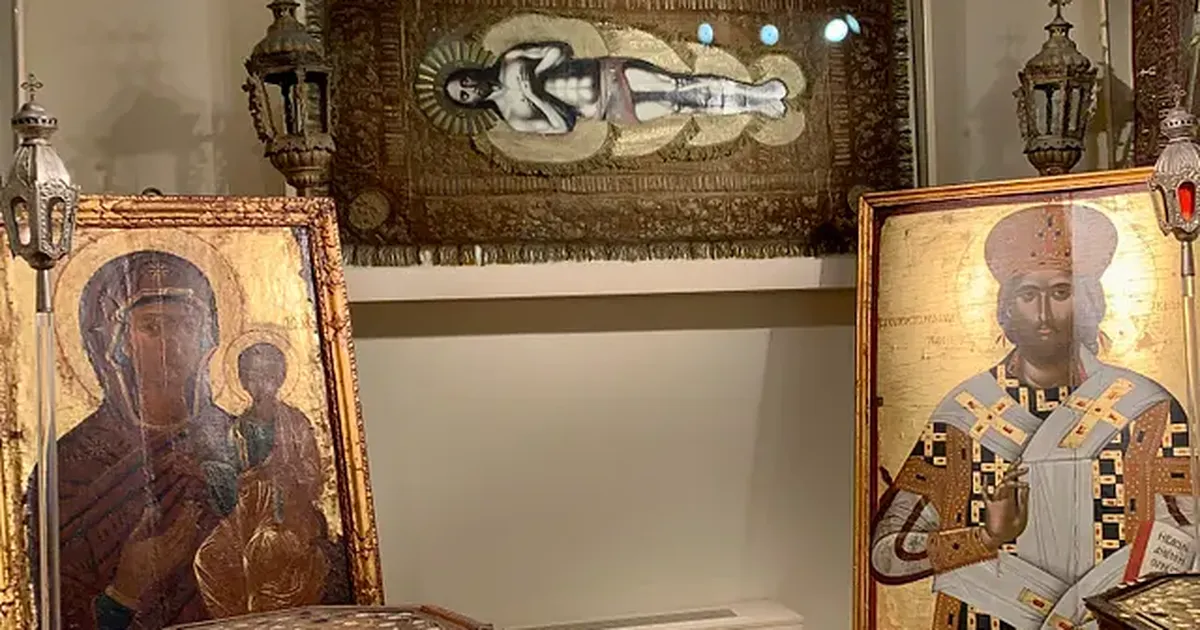
Also from Florence, dating to the same period, come the episcopal throne and the pulpit. The wood-carved epitaphion, the lecterns, the vestments arranged in the monastery's small museum—all carry the accumulated weight of centuries. Visitors who take time inside find themselves moving slowly, not from fatigue but from a natural sense of care. These objects were made to be used, to be touched by liturgical hands, to absorb the smoke of ten thousand candles. That use shows in ways that feel alive rather than worn.
In the courtyard outside, a marble fountain stands apart. Cycladic tradition shapes its design, but something in its proportions makes it memorable—a quiet focal point, the sound of water, the walls that have surrounded this space for so long.
The Feast Days
Two dates mark the monastery's most important celebrations. August 15th observes the Dormition of the Theotokos, one of the most significant feast days in the Orthodox calendar, recognized throughout the Christian world. But the monastery also celebrates its own feast on August 23rd, the Apodosis of the Dormition, when the observance takes on a local character distinct from the broader liturgical calendar. This is the date Mykonians mark most directly—their feast, their monastery, their patron protector.
The monastery served other purposes in more recent history. In the early twentieth century, it functioned briefly as an old age home and then as an orphanage, adapting to the island's changing needs. Today it operates again as an active monastic space, though one open to visitors who approach with appropriate respect.
A Place Worth the Detour
Most visitors to Mykonos never make it here. The beaches pull one direction, the nightlife another, and Ano Mera sits quietly in the middle, patient and unhurried. Those who take the short walk from the village square find a monastery that rewards unhurried attention. The marble bell tower rises against the Cycladic sky. The fountain holds its place in the courtyard. Inside, the iconostasis waits, carved and painted with a care that hasn't diminished with time.
The miraculous icon, when present, draws the faithful and the curious alike. When absent, carried back to Chora for the winter months, the space it occupies still registers. A space for an icon is not merely an empty wall.
Whether you arrive in August for the feast or in any other season for the quiet, Panagia Tourliani offers what the island's livelier attractions often cannot: a sense of continuity, of something that has been here longer than any visitor and will remain after the last ferry departs. In a place often associated with the ephemeral—the season, the party, the summer—this monastery holds something more durable. Faith built it. Time has tested it. The island still knows what it means.